
Aliases: UHMW-PE, PE-UHMW, UHMWPE, TIVAR, Polystone M
Temperature: About -200°C to 80°C
Uses: Wear strips, chain guides, liners, bushings, chute liners, rollers, sliding surfaces
Strengths: Excellent abrasion resistance and high impact strength. Low friction, low moisture absorption, good chemical resistance.
Limitations: Not ideal for tight tolerances or high structural loads. Can creep during machining.
Aliases: High-density polyethylene, PE-HD, King StarBoard, Seaboard, Polystone G
Temperature: About -50°C to 80°C
Uses: Tanks, cutting boards, guards, spacers, outdoor panels, marine components
Strengths: Tough and lightweight. Moisture and chemical resistant. Easy to fabricate.
Limitations: Softer and less wear-resistant than UHMW. Difficult to glue.
Aliases: Low-density polyethylene, PE-LD
Temperature: About -50°C to 70°C
Uses: Flexible liners, pads, low-load components, packaging-related parts, cushioning
Strengths: Soft and flexible. Impact and chemical resistant.
Limitations: Too soft for tight-tolerance or precision wear parts.
Aliases: PP, Polystone P, SIMONA PP
Temperature: About -10°C to 100°C
Uses: Chemical tanks, lab components, food and plating equipment, manifolds, assemblies
Strengths: Very good chemical resistance. Low density and moisture absorption. Good weldability.
Limitations: Brittle at low temperatures. Needs UV stabilization outdoors.
Aliases: Polyvinyl chloride, chlorinated PVC, Corzan, Sintra, Komatex, Boltaron
Temperature: PVC about 0°C to 60°C. CPVC up to about 95°C.
Uses: Chemical-processing parts, tanks, ducts, guards, electrical components, signs, enclosures
Strengths: Good chemical resistance, rigidity, flame resistance. CPVC adds higher heat resistance.
Limitations: Standard PVC can be brittle in cold or high-impact service.
Aliases: PMMA, Plexiglas, Lucite, Perspex, Acrylite
Temperature: About -40°C to 80°C
Uses: Windows, sight glasses, guards, displays, covers, signs, transparent components
Strengths: Excellent optical clarity and UV stability. Stiff. Machines and polishes well.
Limitations: Brittle compared to polycarbonate. May crack at holes or sharp corners.
Aliases: Acrylonitrile butadiene styrene, Cycolac, Lustran, Royalite
Temperature: About -20°C to 80°C
Uses: Housings, guards, covers, prototypes, machine components, fabricated panels
Strengths: Good impact resistance, stiffness, machinability. Formable at moderate cost.
Limitations: Standard grades have limited UV, solvent and high-temperature resistance.
Aliases: PC, Lexan, Makrolon, Tuffak, Zelux
Temperature: About -40°C to 120°C
Uses: Safety guards, machine windows, impact-resistant covers, transparent structural parts
Strengths: Extremely high impact strength. Transparent. Good dimensional stability. Higher heat resistance than acrylic.
Limitations: Scratches more easily than acrylic. May stress-crack with some chemicals.
Aliases: Polyamide, PA6, PA66, Nylatron, Ertalon, Sustamid, MC 901
Temperature: Standard about -40°C to 100°C. Stabilised grades approach 150°C.
Uses: Gears, rollers, pulleys, bushings, sprockets, wear pads, structural machine parts
Strengths: Strong, tough, wear and fatigue resistant. Performs well in gear and bearing applications.
Limitations: Absorbs moisture, which affects dimensions. Grade selection is critical for precision work.
Aliases: POM, POM-H, POM-C, Delrin, Acetron, Ertacetal, Sustarin
Temperature: About -40°C to 100°C
Uses: Precision bushings, gears, valve components, rollers, fixtures, spacers, food-equipment parts
Strengths: Excellent machinability, low moisture absorption. Good dimensional stability, low friction, fatigue resistance.
Limitations: Avoid strong acids, prolonged hot water and steam, and unprotected outdoor UV.
Aliases: Polyethylene terephthalate, Ertalyte, Ertalyte TX, Sustadur PET
Temperature: About -20°C to 110°C
Uses: Precision guides, rollers, bushings, low-moisture-movement components
Strengths: Stiff and dimensionally stable. Low moisture absorption. Good wear resistance, often holds tighter tolerances than nylon.
Limitations: More notch-sensitive than nylon. Avoid strong alkaline environments.
Aliases: Polybutylene terephthalate, Celanex, Valox, Crastin, Sustadur PBT
Temperature: About -30°C to 120°C
Uses: Electrical components, precision parts, housings, reinforced structural components
Strengths: Good dimensional stability and electrical insulation. Chemical resistant. Low moisture absorption.
Limitations: Unfilled grades have lower impact strength than nylon or polycarbonate.
Aliases: Polyphenylene ether, modified PPO, PPE, PPO, Noryl, TECANYL
Temperature: About -40°C to 110°C
Uses: Electrical components, pump and fluid-handling parts, dimensionally stable machine components
Strengths: Low moisture absorption, good dimensional stability. Electrical insulation and hot-water resistance.
Limitations: Chemical resistance varies. Some grades are affected by hydrocarbons or solvents.
Aliases: PU, TPU, urethane, Adiprene, Vibrathane, Estane
Temperature: Commonly -40°C to 80°C. Specialty grades to about 120°C.
Uses: Rollers, wheels, bumpers, scraper blades, seals, wear pads, flexible machine components
Strengths: Excellent abrasion resistance and elasticity. Impact absorption and load-bearing. Wide hardness range.
Limitations: Machining is difficult in soft grades. Resistance is formulation-dependent.
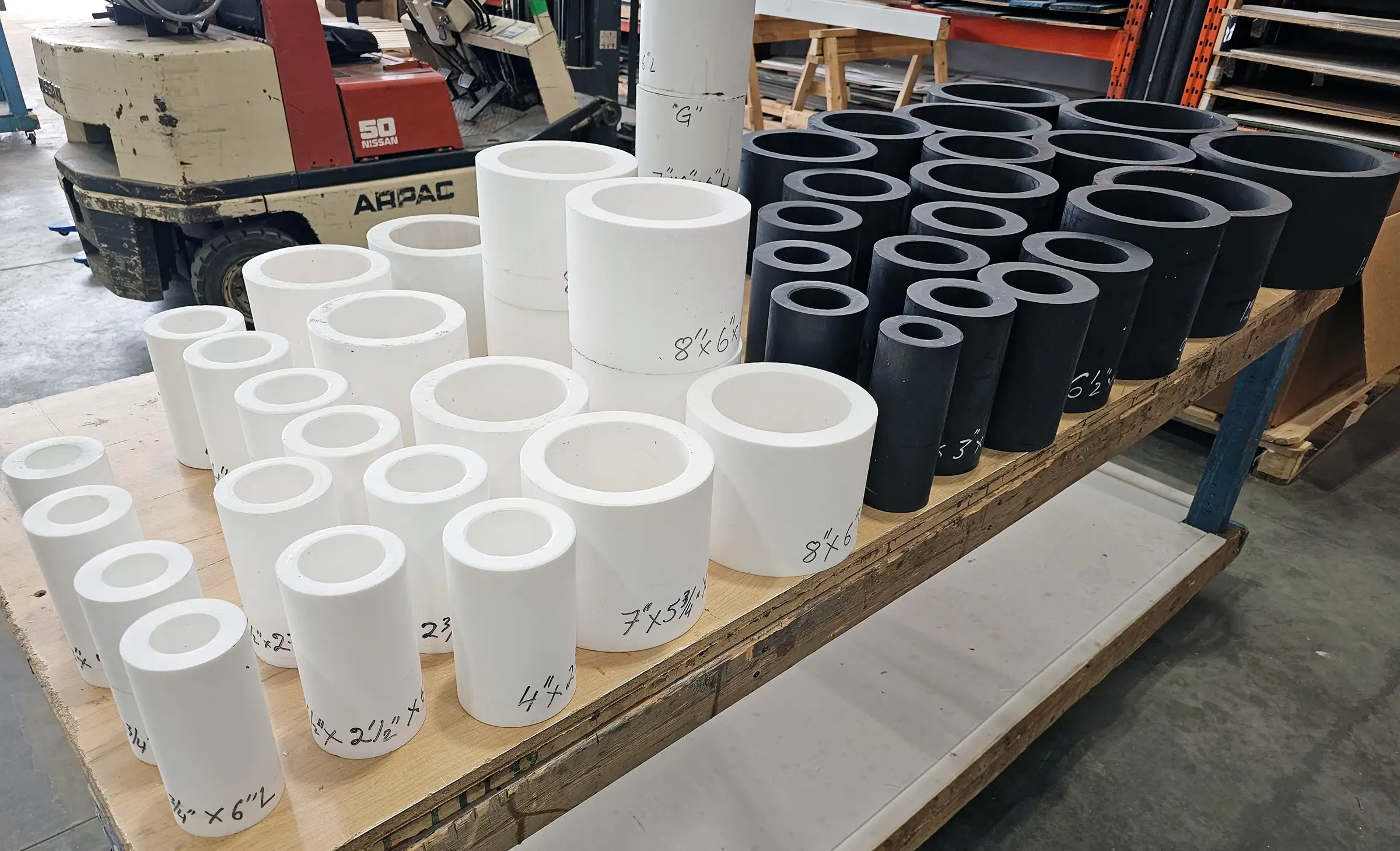
Aliases: Polytetrafluoroethylene, Teflon, Rulon, Fluorosint
Temperature: About -200°C to 260°C
Uses: Seals, valve seats, gaskets, bearings, electrical insulators, chemically exposed components
Strengths: Exceptional chemical resistance, extremely low friction. Excellent electrical insulation, very wide temperature capability. Filled grades using glass, carbon, graphite, bronze or MoS2 improve wear and stability.
Limitations: Virgin PTFE is soft, low in strength, and creeps under load. Cold flow is the failure mode to design around.
Aliases: Polyvinylidene fluoride, Kynar, Solef, Symalit, SIMONA PVDF
Temperature: About -40°C to 150°C
Uses: Chemical-processing equipment, semiconductor parts, high-purity fluid systems, tanks, valves
Strengths: Stronger and more rigid than PTFE. Excellent chemical and UV resistance. High purity, good flame performance.
Limitations: Not resistant to every strong alkaline chemical.
Aliases: Polyether ether ketone, Victrex PEEK, Ketron, Sustapeek, TECAPEEK
Temperature: About -60°C to 250°C
Uses: Aerospace, defence, oil and gas, medical, semiconductor, valve, pump, high-load bearing parts
Strengths: Exceptional strength, chemical and wear resistance. Dimensional stability and high-temperature performance.
Limitations: Very expensive. Grade and filler selection strongly affect properties.
Aliases: Polyetherimide, Ultem, Duratron U1000, Duratron U2300, TECAPEI
Temperature: About -50°C to 170°C
Uses: Electrical components, aircraft interiors, medical equipment, high-temperature structural parts
Strengths: High strength and stiffness, good dimensional stability. Inherent flame resistance with relatively low smoke generation.
Limitations: Usually amber in colour. Lower chemical resistance than PEEK or PPS in some solvents.
Aliases: Polyamide-imide, Torlon 4203, 4301, 4501, 4503, 5530, Duratron PAI
Temperature: About -200°C to 260°C
Uses: High-load bearings, seals, valve seats, compressor parts, aerospace, precision high-temperature parts
Strengths: Extremely high strength, stiffness and wear resistance. High load capacity at elevated temperatures.
Limitations: Very expensive and moisture-sensitive. Machining and post-curing requirements apply.
Aliases: PI, Vespel SP-1, SP-21, SP-22, SP-211
Temperature: Approximately -200°C to 290°C
Uses: Aerospace, vacuum, semiconductor, high-temperature bushings, thrust washers, precision wear parts
Strengths: Exceptional temperature capability and dimensional stability. Low outgassing. Strong wear performance in demanding environments.
Limitations: Among the most expensive materials available. Availability and machining waste are real cost factors.
Aliases: Polyphenylene sulfide, Ryton, Techtron PPS, Techtron HPV, Sustatron
Temperature: About -40°C to 220°C
Uses: Pump, valve, chemical-processing, electrical, high-temperature wear components
Strengths: Excellent chemical resistance, low moisture absorption. Dimensional stability, flame resistance, high-temperature capability.
Limitations: Unfilled PPS can be brittle. Reinforced grades may be abrasive to tooling.
Aliases: Polyphenylsulfone, Radel R, Ultrason P, TECASON P
Temperature: About -50°C to 180°C
Uses: Medical trays, food equipment, plumbing, fluid handling, sterilisable components
Strengths: High impact strength, excellent hydrolysis resistance. Withstands repeated steam sterilisation.
Limitations: Expensive. Not usually selected for low-friction or bearing service.
Aliases: PSU, Udel, Ultrason S, TECASON S
Temperature: About -50°C to 160°C
Uses: Medical, food, laboratory, plumbing, electrical components
Strengths: Good heat resistance, dimensional stability, electrical properties. Hot-water and steam resistance.
Limitations: Can stress-crack with some solvents. Less impact-resistant than PPSU.
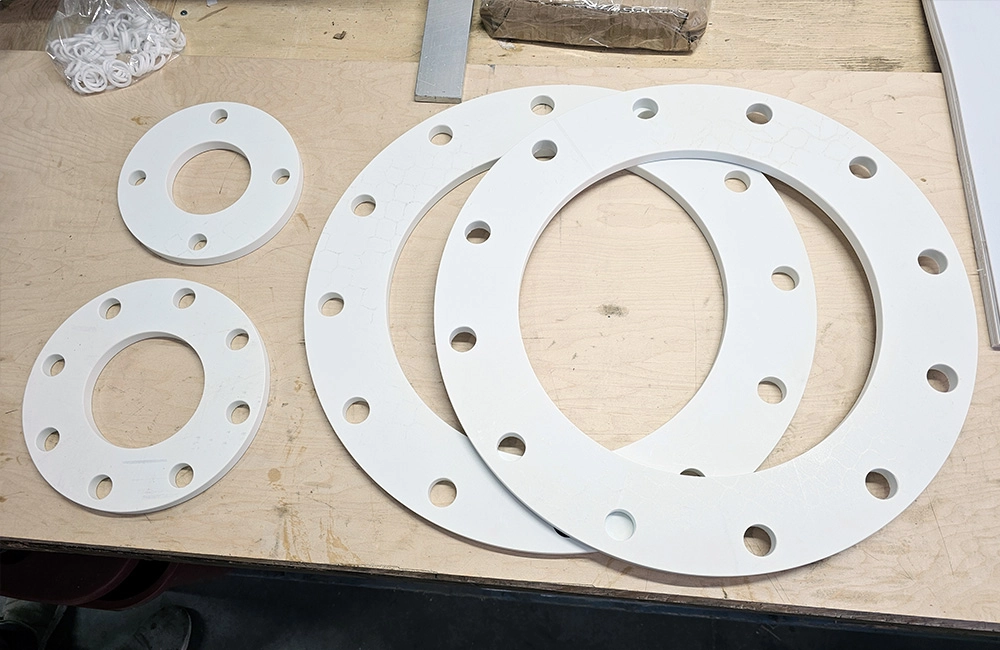
Aliases: Phenolic, laminated phenolic, Micarta, Norplex-Micarta
Temperature: Commonly -40°C to 120°C. Some grades approach 175°C.
Uses: Electrical insulators, wear plates, bushings, gears, guides, structural panels
Grades: Paper, canvas and linen. Designations X, XX, XXX, C, CE, L, LE.
Strengths: Good electrical insulation and compressive strength. Stiff. Good wear properties and creep resistance.
Limitations: Can be brittle. May absorb moisture. Produces hazardous dust when machined.
Aliases: Fibreglass laminate, glass-epoxy, epoxy-glass, Norplex-Micarta, Glastic
Temperature: G10 and FR4 about -50°C to 130°C. G11 and FR5 up to about 180°C.
Uses: Electrical insulation, fixtures, structural plates, spacers, nonconductive parts
Variants: Flame-retardant FR4, high-temperature G11 and FR5
Strengths: High mechanical strength and electrical insulation. Low moisture absorption, good dimensional stability.
Limitations: Very abrasive to tooling. Produces fibreglass dust. Edge delamination needs controlling.
Aliases: NEMA GPO-3, glass-polyester laminate, UPG, Glastic, Rigos
Temperature: Commonly about -20°C to 130°C, continuous to about 140°C
Uses: Switchgear panels, arc chutes, phase barriers, bus-bar supports, insulators
Strengths: Good electrical insulation and arc and track resistance. Rigid, economical structural glass-mat polyester laminate.
Limitations: Lower strength and moisture resistance than G10 or FR4.
Aliases: Nylatron, Rulon, Delrin AF, Ketron HPV, Ertalyte TX, Vespel SP-21
Temperature: Determined by the base resin
Uses: Bearings, bushings, wear rings, thrust washers, guides, static-control components
Fillers: Graphite, carbon, glass, bronze, MoS2, oil, PTFE. Anti-static and conductive grades available.
Strengths: Tailored for lower friction and higher wear resistance, greater strength, better stability, or electrical control.
Limitations: Never assume a filled grade matches the unfilled resin.
Aliases: Ethylene propylene diene monomer, EP rubber
Temperature: About -50°C to 150°C
Uses: Outdoor seals, water-service gaskets, roofing components, steam seals, weather stripping
Forms: Solid, sponge, closed-cell, food-grade
Strengths: Excellent weather, ozone, water, steam and outdoor-aging resistance.
Limitations: Poor resistance to petroleum oils, gasoline and hydrocarbon fuels.
Aliases: CR, chloroprene rubber, polychloroprene, Baypren
Temperature: About -35°C to 100°C
Uses: General-purpose gaskets, pads, seals, vibration isolators, outdoor rubber components
Strengths: Balanced resistance to weather, ozone and moderate oils. Flame and general industrial exposure resistance.
Limitations: Not ideal for severe fuel exposure, extreme cold, or high-temperature service.
Aliases: NBR, Buna-N, acrylonitrile butadiene rubber, Perbunan
Temperature: About -40°C to 120°C
Uses: Oil seals, fuel-system gaskets, hydraulic seals, pads, industrial gasketing
Forms: Standard, high-nitrile, fuel-resistant, food-grade, solid, sponge
Strengths: Good oil, fuel, grease and abrasion resistance.
Limitations: Poorer ozone, sunlight and outdoor-weathering resistance than EPDM or neoprene.
Aliases: CNAF, Garlock BLUE-GARD, KLINGERSIL, Durlon, Teadit, GORE
Temperature: Grade-dependent. Common products about -200°C to 450°C.
Uses: Flange gaskets, equipment seals, pump and valve gaskets, custom-cut sealing components
Types: CNAF, aramid and cellulose fibre, PTFE, expanded PTFE, graphite, rubber-cork
Strengths: Broad range of pressures, chemicals, temperatures and flange conditions.
Limitations: Properties vary by construction and binder. Select by fluid, pressure, temperature, flange design, bolt load and applicable regulation.
What forces will the part experience? Is the load constant, intermittent, compressive, tensile, or impact-related?
Which dimensions are critical? Will expansion, moisture absorption, creep, or internal material stress affect the fit?
Does the part need to insulate, dissipate static, or conduct electricity?
Identify food-contact, traceability, certification, Controlled Goods, RoHS, REACH, PFAS, POPs, or customer-specific requirements before quoting.